
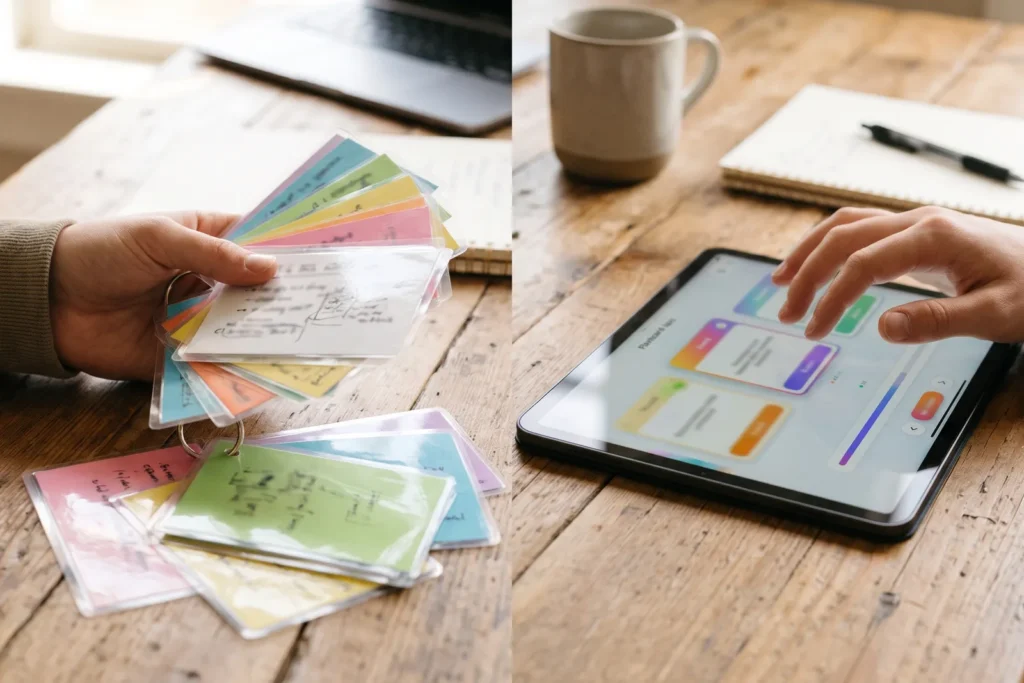
Should your homeschool use paper flashcards or digital ones? It is one of the most common questions parents ask, and the honest answer is: it depends on your child, your day, and your space. Often the best answer is both. Let’s compare them so you can decide with confidence.
The case for physical flashcards
They are hands-on. Many kids learn better when they can touch, sort, stack, and shuffle. Spreading cards across the table to match, order, or group them turns review into play.
They are screen-free. If your family is trying to limit screen time, or your child is already on a device for other schoolwork, paper cards give the eyes a break.
They are simple. No batteries, no passwords, no Wi-Fi. Cards work at the kitchen table, on a road trip, or in the waiting room.
They are easy to organize. Our Henle Latin Flashcards are organized by lesson and held together with metal rings, so you can pull out just the lessons you are studying. Cards are laminated for durability and come in a sturdy box for storage.
Watch for: they take up shelf space, and you have to keep track of them. A box and rings help with both.
The case for digital flashcards
They go everywhere. A phone or tablet is almost always within reach, which makes it easy to squeeze in a few minutes of practice.
They can speak. Hearing correct pronunciation is a real advantage for Latin, especially if you are learning alongside your child. Our digital flashcards include audio so students can hear each term as they practice.
Nothing gets lost. There are no stray cards under the couch or in the minivan.
Watch for: screens come with distractions, and some kids find it harder to focus on a device.
Side-by-side
| | Physical | Digital | |—|—|—| | Hands-on sorting and games | Excellent | Limited | | Screen-free | Yes | No | | Hearing pronunciation | No | Yes (audio) | | Practice anywhere | Yes (carry the box) | Yes (any device) | | Storage | Needs a box or shelf | None | | Best for | Tactile learners, quiet routines | On-the-go review, listening |
Which fits which child?
- The wiggly, hands-on learner usually thrives with physical cards they can sort and shuffle.
- The listener who benefits from hearing the words may enjoy the audio of digital cards.
- The busy, always-on-the-move family will appreciate having practice available on a phone.
- The child who is easily distracted by screens is usually better served by paper.
Why not both?
Using both is a strong approach: physical cards for focused, hands-on sessions at home, digital for quick review and pronunciation on the go. That is why our standard Henle sets include both. The Lessons 1–15 flashcards and the Lessons 16–29 flashcards each come with lifetime access to the digital version, so your child can switch between the two without extra cost.
If you only want the digital version, see the Digital Flashcard Access page for how it works.
A simple way to decide
Not sure yet? Try the free Lessons 1–2 sample and see which way of practicing your child prefers. Pay attention to when they are happiest and most focused; that tells you a lot.
Final thought
Neither format is “better” for everyone. The best flashcards are the ones your family actually uses, day after day. Pick the format (or combination) that makes review feel easy, and consistency will follow.
Ready to look around? Visit the Soul3DLearning shop.

